

Handheld Hydraulic breakers turn pressure and flow into rapid, controlled strikes that free asphalt, concrete, and compacted ground. If you work on utility cuts, patch prep, valve box access, or pipeline repairs, understanding how a handheld hydraulic breaker actually works—and how to set it up—determines whether you get crisp, fast breaking or frustrating weak hits and heat buildup.
This expert guide explains the mechanism, shows how to commission the hydraulic circuit, compares hydraulics with pneumatic and electric options, and gives field-ready playbooks for road maintenance and municipal waterworks crews. We keep it practical and measurable so you can verify performance on-site.
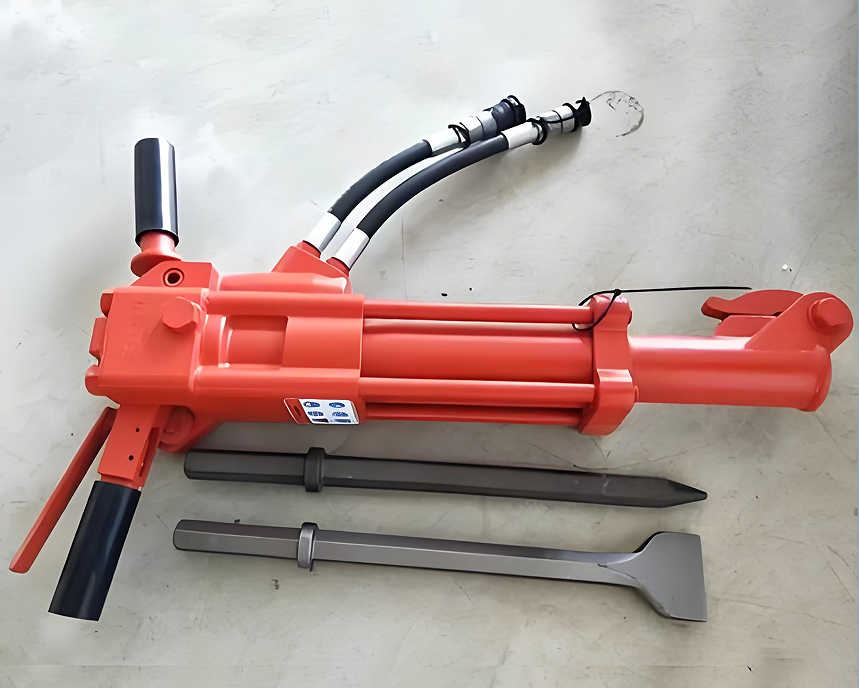
Mechanism and circuit fundamentals
A handheld hydraulic breaker is a percussion tool driven by hydraulic power pack. The pack sends oil at a set flow and pressure through the supply hose to the breaker body. Inside the tool, a spool valve sequences high and low pressure to the piston chambers. The piston accelerates forward and impacts the tool bit; an internal accumulator stores and releases energy between strokes and supports the piston return. Blow energy depends on pressure, flow, valve timing, piston mass and stroke, and the accumulator’s precharge.
Two parameters form the backbone of performance: working pressure and oil flow. Representative handheld classes operate around 20–34 L/min (5–9 GPM) and roughly 105–130 bar working pressure, with model-specific maxima published by OEMs. For example, Hycon’s HH27 class specifies 30 L/min with 130 bar working and 160 bar maximum, and a blow rate near 1,260 blows/min, according to the Hycon catalogue entry for the HH27 class tools in 2019. See the Hycon catalogue reference in the Specs section below.
Return-line backpressure is equally critical. Several handheld ranges, including Atlas Copco’s LH 230 E and LH 400 E, cap return backpressure at 15 bar; planning hoses, quick couplers, and filters to stay below that limit at full flow and operating temperature is essential. Atlas Copco publishes the 15 bar limit on the LH 230 E technical page referenced later in this guide.
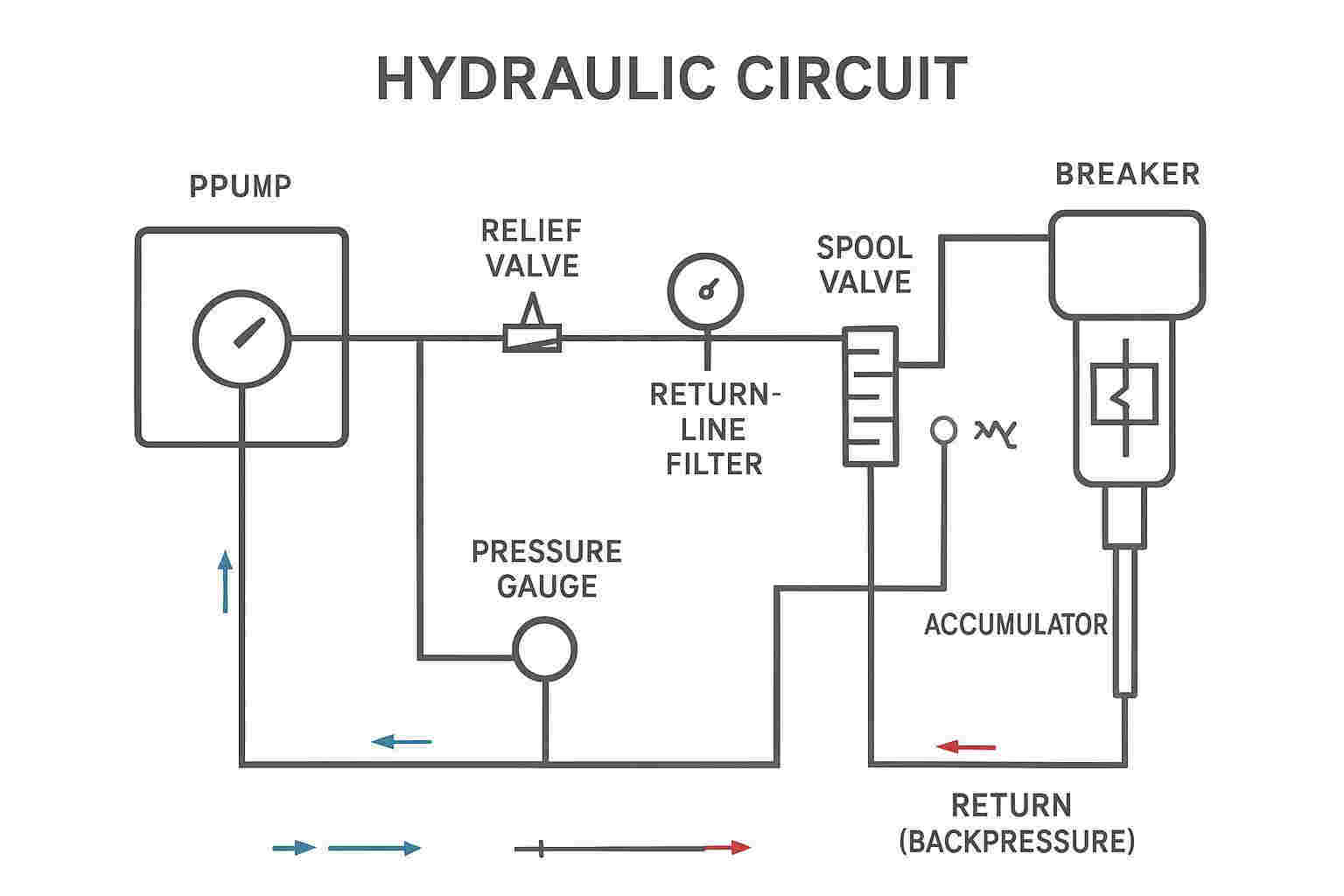
In practice, thermal control closes the loop. Many portable packs specify 70°C (158°F) as the maximum operating oil temperature; aim to run in the 50–70°C band. Cooler fouling or high return restriction will push you toward the limit. Think of the hydraulic system like a breathing athlete: enough flow and pressure deliver power, clear return plumbing lets the system “exhale,” and a clean cooler keeps temperatures in the safe zone.
Setup and commissioning steps for a handheld hydraulic breaker
The fastest way to great breaking is to match the breaker’s hydraulic requirements with a properly instrumented power pack. Here is a concise commissioning sequence you can run on any handheld hydraulic breaker setup.
Measure flow at temperature. Install a calibrated inline flow meter with pressure ports between the pack and the tool. Verify that the delivered flow matches the breaker’s required range at operating viscosity. Tools such as the Parker SensoControl diagnostic kits provide integrated flow, pressure, and temperature measurement; see Parker’s instrumentation guidance for selection and setup in the SensoControl catalog.
Confirm working pressure and relief setting. With the breaker striking on a representative substrate, confirm the pack’s relief and the tool’s working pressure are aligned with the OEM’s specification. Avoid testing cold; verify at temperature so viscosity effects are included.
Check return backpressure. Fit a low-range gauge or use a diagnostic port on the return line. At full flow and temperature, ensure backpressure stays comfortably below the OEM limit (for many Atlas Copco handheld breakers, 15 bar). If it’s high, inspect quick couplers, hose IDs, return filters, and any restrictive fittings.
Control temperature. Monitor oil temperature across a full-duty cycle. If you approach 70°C (158°F), clean the cooler, verify the fan, check ambient airflow, and consider reducing continuous duty or increasing cooling capacity per the power pack manual.
Verify cleanliness and couplers. Clean flat-face couplers before every connection, inspect O-rings, and ensure return filtration is installed and sized for the flow. Set a practical ISO 4406 target of 18/16/13 or cleaner unless your OEM specifies otherwise.
Disclosure: NewaLux is our product. As a neutral example, a NewaLux gasoline hydraulic power pack that supports 20–30 L/min at the breaker ports and includes an air-oil cooler and return-line filtration can be set up exactly as described above. The point is the process: instrument the circuit, confirm flow/pressure, verify backpressure, and keep oil clean and cool.
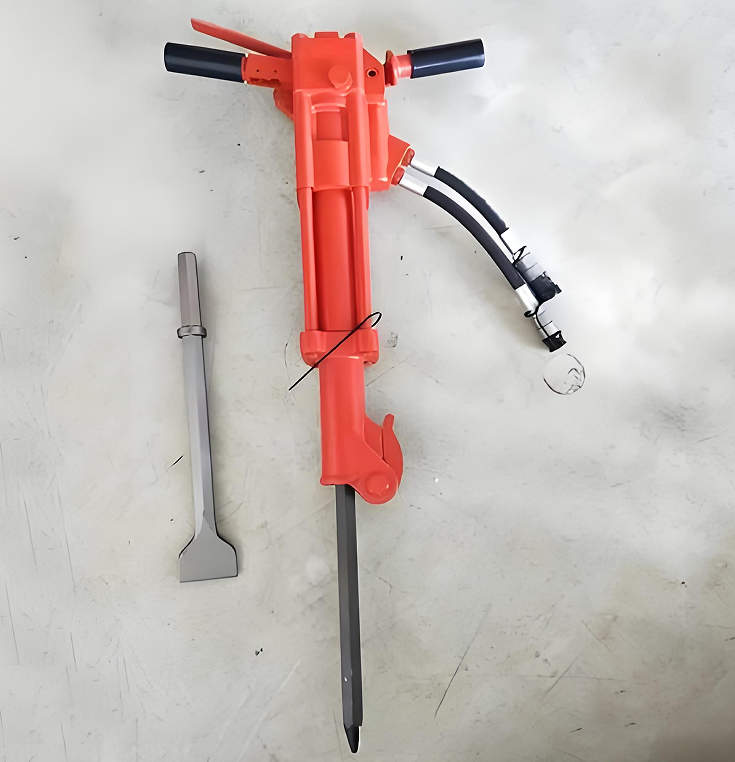
Operational advantages vs pneumatic and electric
Hydraulics earned their place on roads and at waterworks because they deliver high power density with compact hose sets and reliable energy transfer. Compared with a pneumatic breaker, you avoid the mass and fuel consumption of a large tow-behind compressor and reduce energy losses tied to compressing and transporting air. Versus many electric hammers, a matched hydraulic breaker and pack can sustain heavy-duty cycles with consistent impact force and fewer thermal trips—especially outdoors in dusty or wet conditions.
Portability is a trade: the power pack adds one more unit to stage, but the hoses are slim, and the breaker head remains compact for precise work around utilities. Reliability is driven by simple, sealed hydraulics; maintenance focuses on oil cleanliness, hose condition, and cooler health rather than air moisture management or generator load sharing. On the human side, consider noise and vibration: hydraulic systems can reduce airborne noise at the prime mover compared with diesel compressors, but the tool’s percussive noise remains significant, so hearing protection is still required. For vibration exposure, manage trigger time against published HAVS action and limit values; see the Safety section for details and calculators.
Use-case playbooks for road and waterworks
Road utility cuts and asphalt breakout. Score or saw your cut line to prevent slab wander, then run the handheld hydraulic breaker near-vertical with an asphalt cutter bit to open seams. Transition to a moil or chisel to lift and fragment the slab. Maintain steady downforce without leaning; rotate the bit slightly between penetrations to keep edges sharp. Sequence impacts to relieve stress and avoid binding near rebar or utility crossings.
Valve box access and pipeline repair prep. Start with conservative blow rates and controlled thrust around known or suspected utilities. Use a chisel bit to peel material in thin layers toward the target. Dust suppression may be appropriate where permitted. Keep the breaker vertical to minimize lateral damage. In wet or muddy conditions, lay hose supports to protect couplers and reduce tripping hazards.
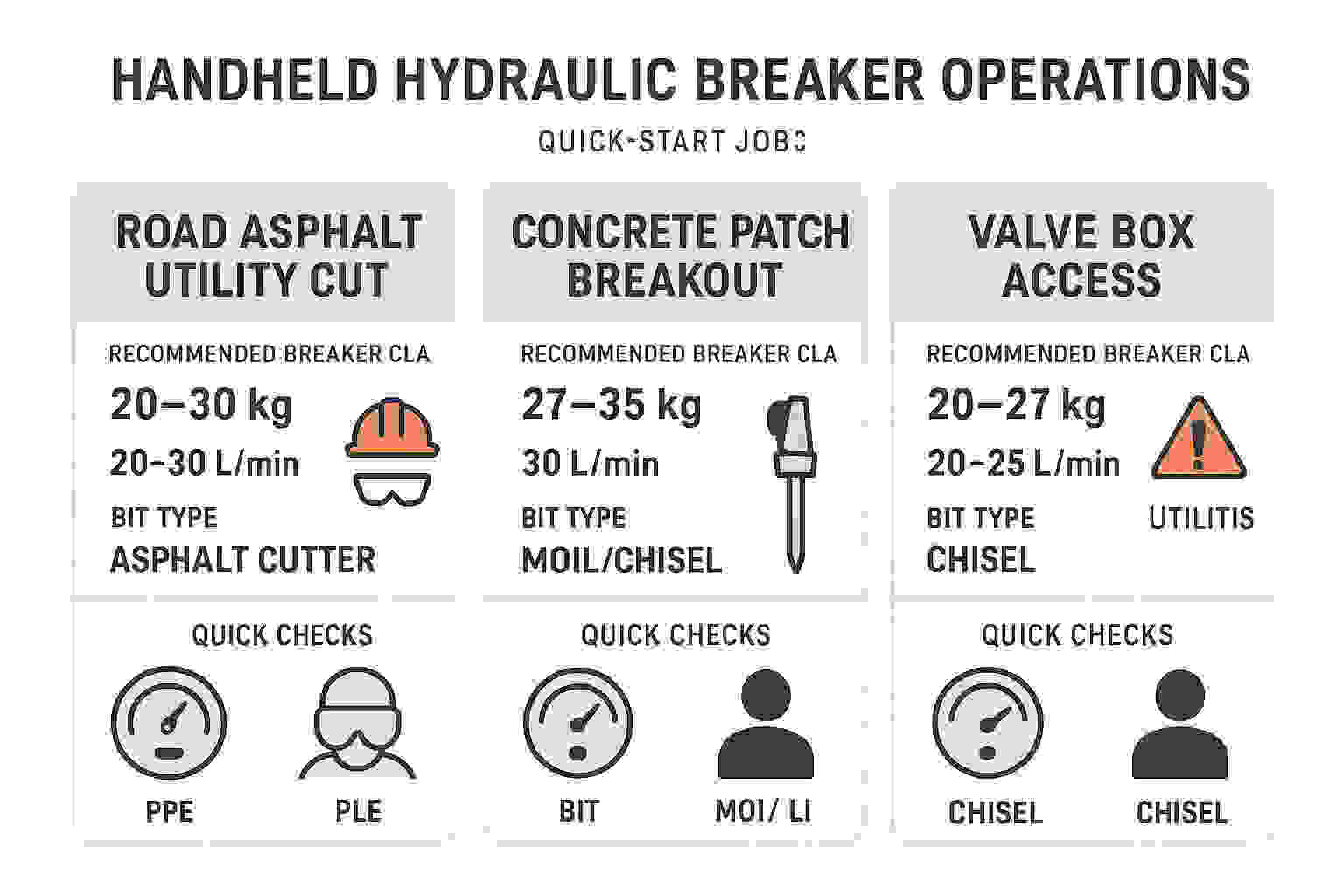
Bit selection matters. Asphalt cutters open seams efficiently; moils generalize breaking and starting holes; chisels slice and steer in concrete and around castings. Match shank and length to your breaker family and confirm retention system compatibility before the shift.
Troubleshooting by symptom with measurement anchors
Weak hits or slow progress. First, confirm the basics: couplers fully seated and clean, correct bit for material, and adequate thrust without leaning. Instrument the circuit. If flow is low at temperature, check the power pack’s engine speed and pump displacement setting; verify the pack’s relief is not opening prematurely. If return backpressure exceeds the OEM limit, inspect undersized hoses or clogged return filters. If the breaker still strikes weakly with correct hydraulics, the accumulator may be undercharged or the internal valve leaking; follow the tool manual’s procedure for accumulator nitrogen checks.
Overheating and hot oil. Oil temperature creeping toward 70°C usually points to cooler fouling, insufficient airflow, excessive throttling, or high return restriction. Clean the cooler, confirm fan operation and ambient ventilation, and measure return backpressure at full flow. Verify oil grade against ambient; too high a viscosity in cold starts can force relief and build heat.
Irregular striking or “air hammering.” Erratic blows often trace to aeration or inlet issues at the power pack: low oil level, blocked suction strainers, or loose fittings drawing in air. Quick couplers with damaged seals can also entrain air. Bleed air per pack procedure, correct suction restrictions, and replace suspect couplers. If symptoms persist with hydraulics confirmed, consult the breaker service manual for valve timing issues.
Maintenance and contamination control
Daily, keep flat-face couplers spotless before connection, inspect hoses for abrasion and bulges, and check the bit/tool retainer for wear. Weekly, clean the power pack cooler and verify the fan, inspect hose routing and supports, and review any filter differential indicators. Monthly or each 250 operating hours, change the return-line filter element per indicator or hours, and take an oil sample for particle count. Semiannually, check accumulator nitrogen precharge and inspect seals as your OEM recommends. A practical cleanliness goal for many mobile breaker circuits is ISO 4406 code 18/16/13 or better; align with the most sensitive component in your circuit and confirm with your OEM’s maintenance documentation.
Safety essentials including HAVS
Vibration exposure. Manage trigger time with the HAVS framework. The Exposure Action Value is 2.5 m/s² A(8) and the Exposure Limit Value is 5.0 m/s² A(8). The UK regulator provides a calculator and points system to plan rotations and limits; see the Health and Safety Executive’s guidance on hand-arm vibration for the A(8) method and calculators.
Hearing protection. Percussive tools and engine-driven packs can exceed action levels. OSHA’s occupational noise exposure standard sets a permissible exposure limit of 90 dBA over 8 hours and an action level at 85 dBA 8-hour TWA that triggers a Hearing Conservation Program. Consider double protection for sustained high-level, impulsive environments and verify compliance with site dosimetry.
Hose and coupler handling. Treat hydraulic hoses as high-energy components: depressurize before disconnect, keep hands away from potential pinholes, and never wipe leaks with bare skin. Use sleeves and supports to reduce tripping hazards and abrasion. For urban roads, add traffic control and clear hose routing across lanes or sidewalks to protect crews and the public.
Next steps
If you manage a mixed fleet, standardize your commissioning process—measure flow, confirm pressure, cap backpressure, and control temperature—so any handheld hydraulic breaker performs as expected. For examples of packs with cooling and filtration features suited to field work, see the NewaLux hydraulic power packs category hub.